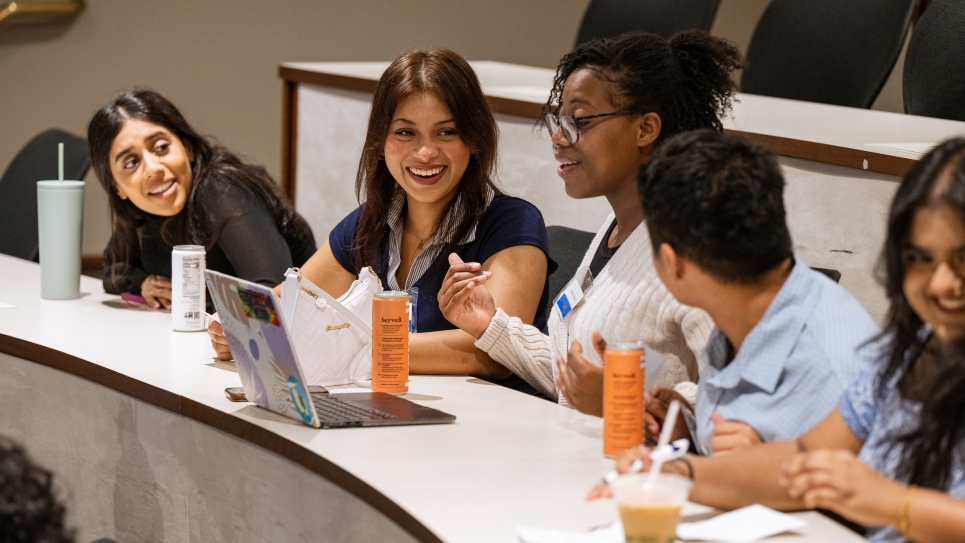
Students discuss a project at the workshop organized by ALCF in collaboration with NERSC and OLCF. Image: Argonne National Laboratory
Students discuss a project at the workshop organized by ALCF in collaboration with NERSC and OLCF. Image: Argonne National Laboratory
Bringing together participants from a range of science disciplines, the Argonne Intro to HPC Bootcamp focuses on foundational concepts in high-performance computing to help participants apply them to projects focused on real-world challenges.
The U.S. Department of Energy's (DOE) computing facilities, the Argonne Leadership Computing Facility (ALCF), the National Energy Research Scientific Computing Center (NERSC), and the Oak Ridge Leadership Computing Facility (OLCF), are working together to support the next generation of scientific computing talent through immersive, hands-on training opportunities.
This summer, the three facilities welcomed a new cohort of students for the second Introduction to High-Performance Computing (HPC) Bootcamp. The weeklong event brought together undergraduate and early-career graduate students from across the country for an intensive, project-based learning experience focused on applying computational and data science tools to real-world energy challenges.
This year’s program marked the second offering of the bootcamp, which began in 2023 as a multi-laboratory collaboration. The 2025 event was hosted by Argonne National Laboratory and organized by ALCF in collaboration with NERSC and OLCF.

The Argonne Introduction to High-Performance Computing Bootcamp is a one-week immersive experience designed for STEM students to learn fundamental HPC concepts while applying computational and data science tools to complex application problems. Image: Argonne National Laboratory
“We hope that the participants not only connect with the information, but with each other,” says Paige Kinsley, ALCF Education Outreach Lead and the program director for the bootcamp. “Our goal is to build and foster an environment where these students can develop relationships and connections that last well beyond the bootcamp.”
Designed for students with coding experience but no prior exposure to supercomputing, the bootcamp aims to demystify HPC through foundational training and collaborative problem solving. Participants worked in small groups, supported by peer mentors and national laboratory staff, to explore core HPC concepts such as parallel processing, cluster computing and model building.
“It’s a lot about creating awareness of these jobs and bringing supercomputers to those who might be interested,” says Rebecca Hartman-Baker, who leads the User Engagement Group at NERSC. “Events like this help train and prepare the next generation of computational scientists.”
Throughout the week, students participated in hands-on project work, heard from keynote speakers on the role of HPC and AI in solving energy problems, and engaged with the national lab community through networking events and career panels. A tour of the ALCF provided students with an up-close look at world-class computing systems and the critical role they play in advancing scientific discovery.
“Activities like this are important on-ramps for science and computing careers because they rapidly introduce students to important ideas,” says Suzanne Parete-Koon, ORNL Computing Workforce Initiative Lead. “Opportunities like this provide students with personal accomplishments and natural conversation starters for networking with the computing community during and after the event.”

ALCF’s Paige Kinsley guides participants through a session on how the bootcamp will deepen their HPC knowledge and skills. Image: Argonne National Laboratory
Rene Montelongo, who studies electrical and computer engineering at California State University, Northridge (CSUN), attended the first bootcamp in 2023 as a participant and returned this year as a peer mentor. Since attending bootcamp, HPC has played a major role in his academic path, helping him land a 2024 internship at Lawrence Livermore National Laboratory and a spot in CSUN’s NASA-sponsored ARCS (Autonomy Research Center for STEAMH) program, where he’s working on additive concrete manufacturing for Martian habitats.
“When I attended the first workshop, I didn’t know what HPC was,” says Montelongo, “But events like this feel like checkpoints to me, because by the end they solidify that I am capable and lead to new exciting opportunities ahead.”
Valeria Gonzalez from the College of DuPage in Illinois attended the workshop to further pursue her interest in coding and computer science.
“This program rekindled my curiosity and desire to learn about computational science again,” says Gonzalez. “There are a lot of transferable skills I obtained from this bootcamp that I can apply in the future.”
Gonzalez says she was intimidated at first to apply, but after her experience urges anyone interested to apply as well.
“I was a little hesitant at first because I am a beginner, but everyone was welcoming and used their different skill levels to assist each other,” says Gonzalez.
By the end of the bootcamp, participants not only gained technical knowledge but also built connections with peers, mentors, and researchers working at the forefront of HPC innovation. As the DOE continues to invest in developing the computational science workforce, the Intro to HPC Bootcamp serves as a powerful example of how early-career engagement can help shape the future of the field.
“You have to start somewhere," says Justin Dunbar, a bootcamp participant from Howard University. “The concepts can feel intimidating at first and you don’t know where to begin, but this exposure gave me the confidence and knowledge to further pursue my interests in the field of HPC.”