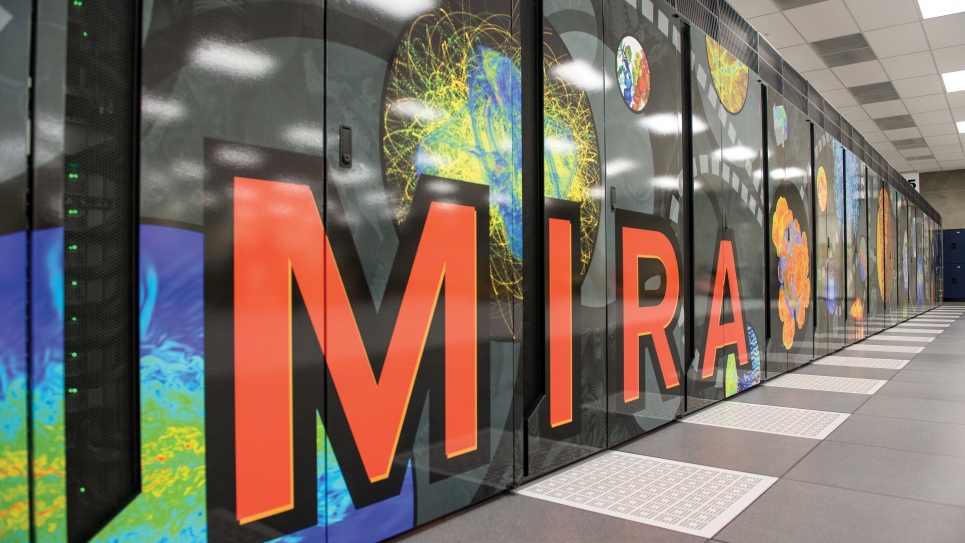
Mira
"We are doing science at the bleeding edge, and our challenge is to maximize application performance on significantly more cores while dramatically reducing the power requirements. Mira is the first petascale system that delivers many of the features that will be needed as we push towards exascale." - Michael Papka

Mira Ushers in a New Era of Scientific Supercomputing

Mira, the new petascale IBM Blue Gene/Q system being installed at the ALCF, will usher in a new era of scientific supercomputing. An engineering marvel, the 10-petaflops machine is capable of carrying out 10 quadrillion calculations per second.

The ALCF is committed to delivering 786 million core hours on Mira in 2013. In full production mode starting in 2014, over 5 billion computing hours will be allotted to scientists each year.

Mira—On the Forefront of Green Supercomputing

As computers become faster and more powerful, they also need to become more energy efficient to be practical and sustainable. Through a combination of innovative new chip designs and extremely efficient water cooling, Mira will be five times more energy efficient than Intrepid, its Blue Gene/P predecessor at the ALCF. Blue Gene/Q systems currently hold the top five spots on the Green500 list that ranks the top 500 supercomputers in the world by energy efficiency.

Gearing Up for Mira—The ALCF’s Early Science Program

The Early Science Program (ESP) aims to prepare key applications for the architecture and scale of Mira, and to solidify libraries and infrastructure that will pave the way for other future production applications. ALCF staff is working with 16 research teams from across the nation to port and tune their codes on Blue Gene/Q prototype hardware.

Early Science Projects

sort descending
Ab-initio Reaction Calculations for Carbon-12 Ab-initio Reaction Calculations for Carbon-12
Steven C Pieper
ESP 2010 to 2013
110 Million Hours
Accurate Numerical Simulations Of Chemical Phenomena Involved in Energy Production and Storage with MADNESS and MPQC
Robert Harrison
ESP 2010 to 2013
150 Million Hours
Climate-Weather Modeling Studies Using a Prototype Global Cloud-System Resolving Model Climate-Weather Modeling Studies Using a Prototype Global Cloud-System Resolving Model
Venkatramani Balaji
ESP 2010 to 2013
150 Million Hours
matter distribution in the universe Cosmic Structure Probes of the Dark Universe
Salman Habib
ESP 2010 to 2013
150 Million Hours
Direct Numerical Simulation of Autoignition in a Jet in a Cross-Flow Direct Numerical Simulation of Autoignition in a Jet in a Cross-Flow
Christos Frouzakis
ESP 2010 to 2013
150 Million Hours
Global Simulation of Plasma Microturbulence at the Petascale & Beyond
William Tang
ESP 2010 to 2013
50 Million Hours

In the News

Allinea DDT Resolves an Unsolved Mystery at Argonne National Laboratory
Allinea.com
Big Data Week Day 2: How Argonne is using supercomputer Mira to crunch mega-sized data to create visualizations from the formation of galaxies to aneurysms
WBEZ Blog: Day x Datum
Time-Lapse Video Shrinks Birth of a Supercomputer to 3 Minutes
Wired.com

Featured Videos

Introducing Mira: Our Next-Generation Supercomputer

Interview w/ Michael Papka on Chicago Tonight