
ALCF Service-Enabled Science Series kicks off with webinar on experiment-time computing
The first session in the ALCF’s Service-Enabled Science training series explored how the facility’s computing resources and services are accelerating experimental research at the Advanced Photon Source (APS). The webinar, “ALCF On-Demand: Integrated Research Infrastructure for Experiment-Time Computing with Globus Tools,” led by Christine Simpson from ALCF and Hannah Parraga from APS, is now available on ALCF’s YouTube channel.
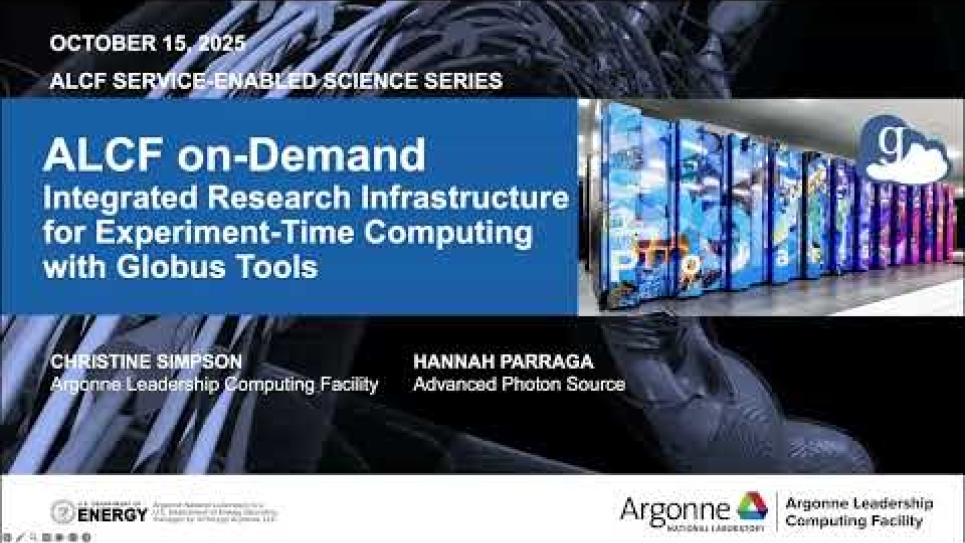
Simpson and Parraga covered the use on-demand queues, service accounts, and Globus tools to connect APS beamlines with ALCF supercomputers. This setup enables near real-time data processing, allowing researchers to make decisions during experiments rather than waiting weeks or months for results. Example cases at the APS X-ray Photon Correlation Spectroscopy (XPCS) beamline, which studies material dynamics under changing conditions, demonstrated how the automated services link experiments to ALCF’s Polaris system for rapid data analysis.
The Service-Enabled Science series is designed to help researchers leverage ALCF resources, services, and tools to streamline workflows, enable secure collaboration, and access high-performance computing for experimental, observational, or large-scale simulation datasets. Future sessions will include additional webinars and hands-on training, featuring real-world workflows and success stories from teams accelerating their science using ALCF resources.