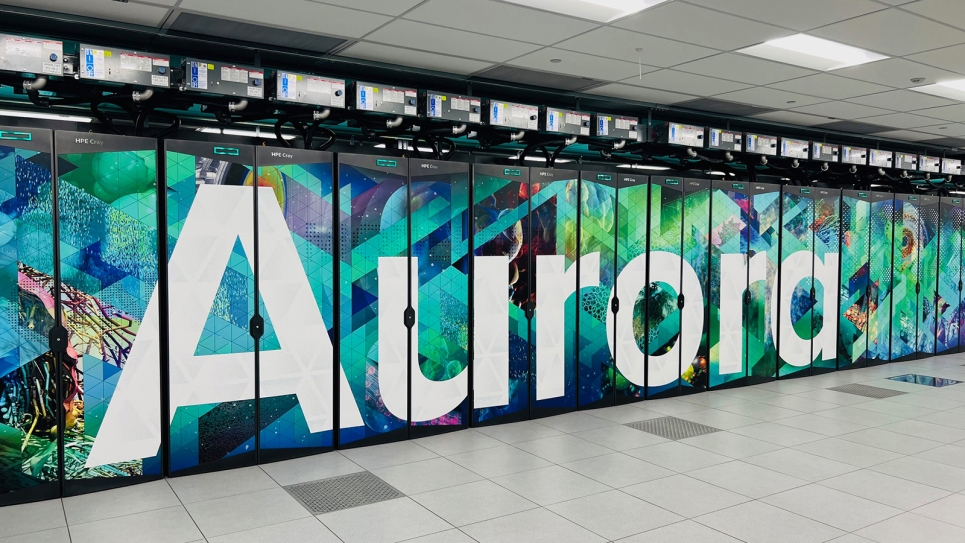
Built in collaboration with Intel and HPE, Argonne’s Aurora exascale supercomputer provides advanced capabilities for simulation, AI, and data analysis. (Image: Argonne National Laboratory)
Built in collaboration with Intel and HPE, Argonne’s Aurora exascale supercomputer provides advanced capabilities for simulation, AI, and data analysis. (Image: Argonne National Laboratory)
DOE’s exascale supercomputers, including ALCF's Aurora, enable breakthroughs in AI-driven Earth systems science, cosmological simulations, light-matter dynamics, and quantum materials research.
Four research teams supported by the U.S. Department of Energy’s (DOE) Argonne National Laboratory have been named finalists for the Association of Computing Machinery’s (ACM) prestigious 2025 ACM Gordon Bell Prize, including one project in the running for the Gordon Bell Special Prize. The Gordon Bell Prize recognizes outstanding achievement in using high performance computing.
Across the four projects, researchers used the nation’s exascale supercomputers to push the limits of simulation and AI for science. The efforts range from simulating quantum materials and the universe at unprecedented scale to building an AI model that produces sharper, longer-range forecasts.
The projects ran on DOE supercomputers, including Aurora at the Argonne Leadership Computing Facility (ALCF) and Frontier at the Oak Ridge Leadership Computing Facility (OLCF). The ALCF and OLCF are DOE Office of Science user facilities. The winners will be announced at the Supercomputing Conference (SC25), held in St. Louis from Nov. 16 to 21.
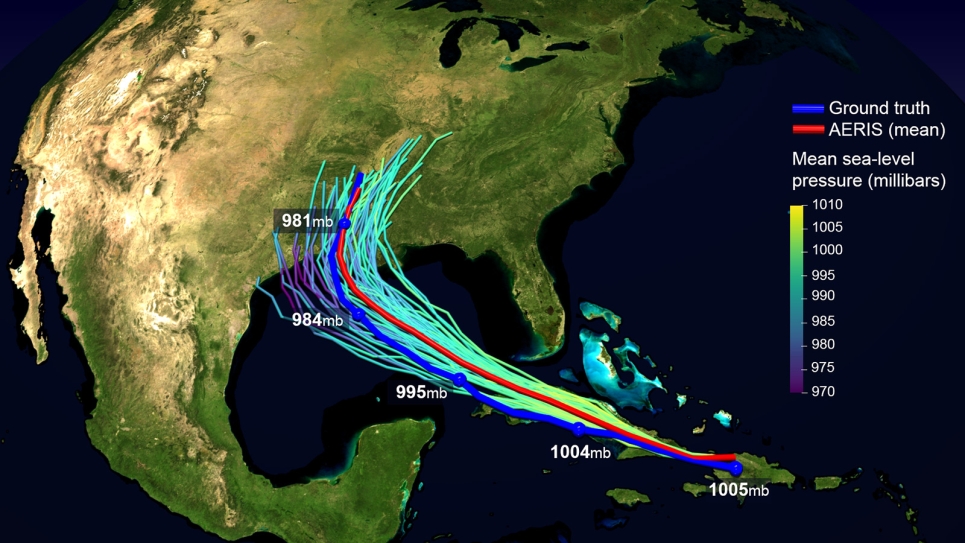
Forecast ensemble tracks from AERIS for Hurricane Laura, showing the path 5 days before landfall on the U.S. coast. (Image: ALCF Visualization and Data Analytics Team)
The Argonne Earth Systems Model for Reliable and Skillful Predictions (AERIS) is a billion-parameter AI model designed to produce high-resolution forecasts from hours to months into the future. Built and trained on Aurora, it reached more than 11 exaflops of mixed-precision performance and produced stable forecasts out to 90 days.
To achieve this, the team developed a method called Sequence Window Parallelism (SWiPe). This approach efficiently distributes the model’s compute tasks and data across Aurora’s more than 60,000 GPUs while reducing communication between them. In tests, AERIS outperformed conventional models, showing the potential of AI models to improve subseasonal-to-seasonal forecasting.
The study, “AERIS: Argonne Earth Systems Model for Reliable and Skillful Predictions,” was authored by Väinö Hatanpää, Eugene Yu, Jason Stock, Murali Emani, Sam Foreman, Chunyong Jung, Sandeep Madireddy, Varuni Sastry, Sam Wheeler, Huihuo Zheng, Troy Arcomano, Venkatram Vishwanath and Rao Kotamarthi from Argonne; Ray A. O. Sinurat from the University of Chicago; and Tung Nguyen from the University of California, Los Angeles.
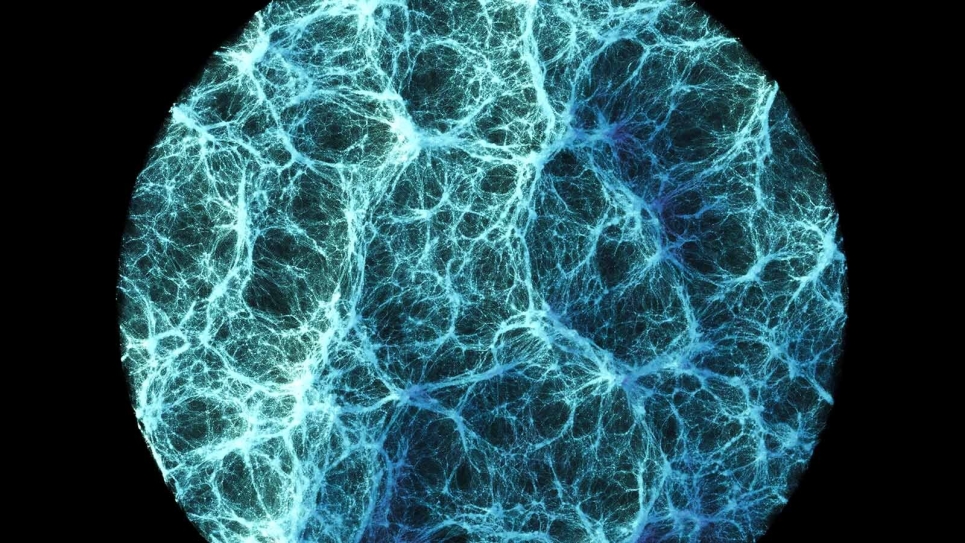
The Frontier Exascale (Frontier-E) simulation sets a new benchmark in cosmological modeling. (Image: ALCF Visualization and Data Analytics Team)
An Argonne-led team, including ALCF staff members, ran the largest full-sky cosmological simulation to date on Frontier. Using the CRK-HACC (Conservative Reproducing Kernel Hardware/Hybrid Accelerated Cosmology Code) code, the team’s simulation modeled cosmic evolution with over 4 trillion particles. This is more than 15 times larger than previous efforts. It captured both gravitational effects and the behavior of gas and stars across a volume comparable to modern sky surveys.
The simulation achieved more than 500 petaflops of peak performance and produced over 100 petabytes of data in just over a week. These results set a new standard for performance and fidelity in modeling the universe and provide a framework for future studies into dark matter, dark energy and the evolution of the universe.
The study, “Cosmological Hydrodynamics at Exascale: A Trillion-Particle Leap in Capability” was authored by Nicholas Frontiere, J.D. Emberson, Michael Buehlmann, Esteban Rangel, Salman Habib, Katrin Heitmann, Patricia Larsen, Vitali Morozov and Adrian Pope from Argonne; Claude-André Faucher-Giguère from Northwestern University; and Antigoni Georgiadou, Damien Lebrun-Grandié and Andrey Prokopenko from DOE’s Oak Ridge National Laboratory (ORNL).
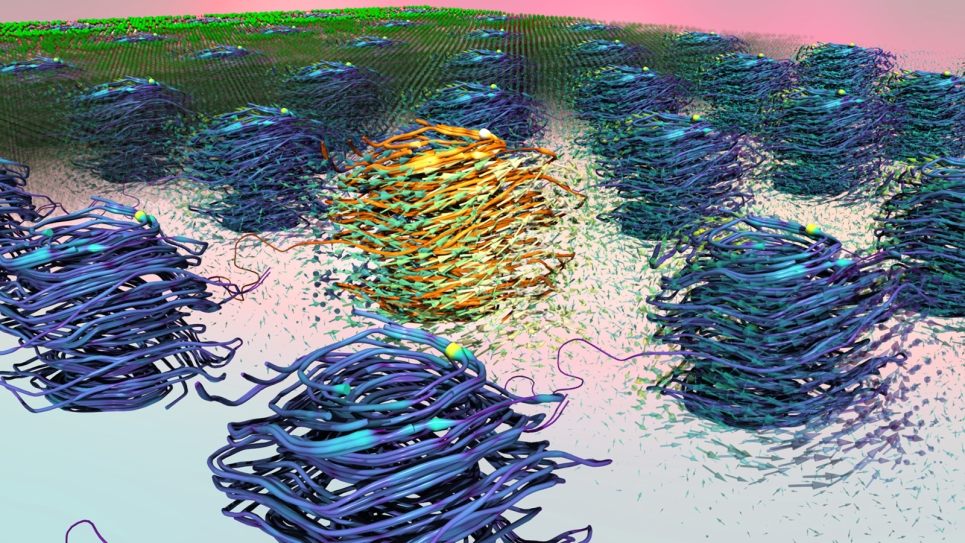
Photo-switching of a ferroelectric nanoscale structure in lead titanate. (Image: ALCF Visualization and Data Analytics Team)
A team led by the University of Southern California (USC) used Aurora to carry out massive simulations of light interacting with quantum materials. Their simulations reached a sustained performance of 1.87 exaflops. Using their novel Multiscale Light-Matter Dynamics framework, the team modeled systems of more than one trillion atoms, the largest simulations of their kind to date.
This work demonstrates how combining physics simulations with AI can reveal new insights into complex materials. By integrating a foundation model called Allegro-FM, the researchers opened the door to simulating atomic behavior across the periodic table. Their findings aim to improve understanding of how light can alter quantum materials. These insights could help design ultrafast, low-power electronic devices.
The study, “Multiscale Light-Matter Dynamics in Quantum Materials: From Electrons to Topological Superlattices,” was authored by Taufeq Mohammed Razakh, Aiichiro Nakano, Ken-ichi Nomura, Rajiv Kalia and Priya Vashishta from USC; Thomas Linker from SLAC National Accelerator Laboratory; Ye Luo from Argonne; Nariman Piroozan, John Pennycook and Nalini Kumar from Intel; Albert Musaelian, Anders Johansson and Boris Kozinsky from Harvard University; Fuyuki Shimojo from Kumamoto University; and Shinnosuke Hattori from Sony Group Corporation.
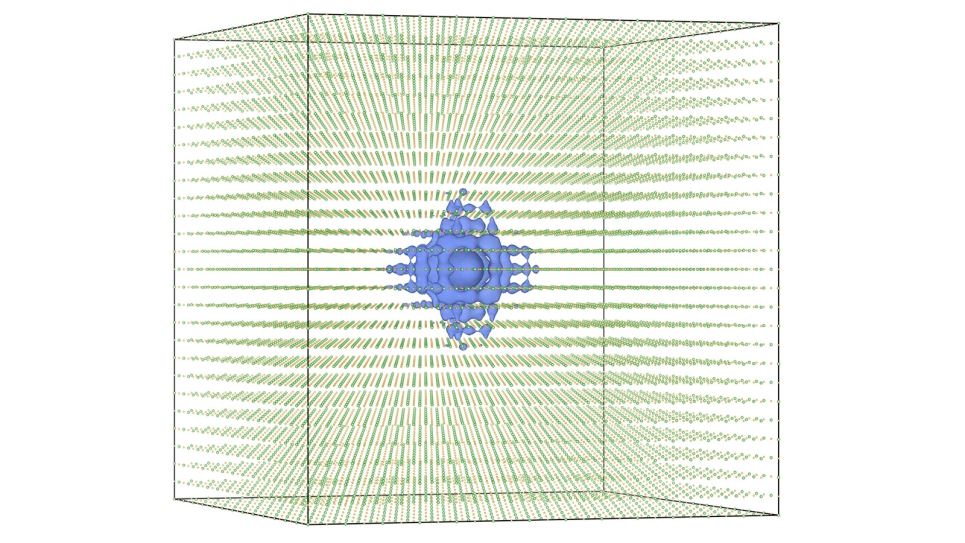
Charge density of a defect state in a 17,574-atom lithium hydride (LiH) supercell. (Image: Chih-En Hsu, USC)
Another USC team broke new ground in simulating quantum materials using Aurora, Frontier and DOE’s Lawrence Berkeley National Laboratory’s Perlmutter system. By improving the open-source BerkeleyGW software, the team carried out dynamic simulations that track how electrons and nuclei interact across tens of thousands of atoms with high precision. The name “GW” comes from the two quantities it calculates. G measures the motion of an electron through a material and W measures how electrons influence each other.
Their simulations achieved more than 1 exaflops on Frontier and 0.7 exaflops on Aurora. Running on multiple supercomputers showed their methods can be used across various hardware. The team’s work provides powerful new tools to advance the design of future quantum technologies.
The study, “Advancing Quantum Many-Body GW Calculations on Exascale Supercomputing Platforms,” was authored by Benran Zhang, Zhenglu Li and Chih-En Hsu from USC; Mauro Del Ben, Daniel Weinberg, Steven Louie and Jack Deslippe from Berkeley Lab; Aaron Altman, Yuming Shi and Felipe da Jornada from Stanford University; James White III from ORNL; and Derek Vigil-Fowler from DOE’s National Renewable Energy Laboratory.