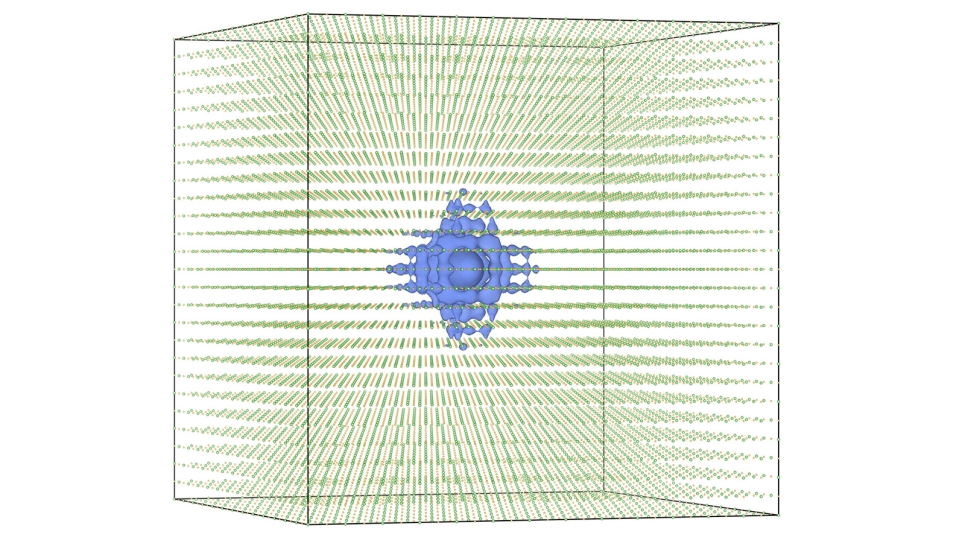
A fundamental question in nuclear physics is understanding how visible matter forms from elementary particles like quarks and gluons, which can be profoundly addressed by quantifying the multi-dimensional structure of nucleons and mesons. Using ALCF resources and advanced theoretical frameworks, a research team has generated a detailed 3D quark image of the pion, the lightest meson responsible for the spontaneous breaking of chiral symmetry in the strong force.
Challenge
Scientists have long been interested in finding and understanding the distribution of quarks within composite particles held together by the strong nuclear force. For the lightest of these particles, the pion, there are no experimental results to rely on, so scientists are using large-scale computation to reveal their internal structure. The research team utilized the Polaris supercomputer to simulate the fundamental theory of the strong force and unveiled a detailed 3D image of the pion, the lightest particle composed of a quark and an antiquark.
Approach
Using ALCF resources, the researchers calculated the quark generalized parton distribution (GPD) of the pion to create a detailed 3D image of it. This calculation is based on the lattice formulation of quantum chromodynamics, the fundamental theory of the strong force, and employs advanced techniques from the Large Momentum Effective Theory framework. The pion GPD is determined with controlled systematic uncertainties across different quark longitudinal momentum fractions x (fraction of quark momentum along the direction of the pion motion) and in the transverse plane (perpendicular to the pion motion).
Results
The results reveal that the transverse size of the pion decreases as x increases (a pattern also seen in the proton) and that the effective size of the pion is smaller than that of the proton at moderate x values.
Impact
Because there currently are no experimental measurements of the pion GPD, the obtained theoretical
findings will provide valuable guidance and support for experiments such as those at Jefferson Lab and the future Electron-Ion Collider at Brookhaven National Laboratory.
Publications
Ding, H.-T., X. Gao, S. Mukherjee, P. Petreczky, Q. Shi, S. Syritsyn, and Y. Zhao. “Three-Dimensional Imaging of Pion Using Lattice QCD: Generalized Parton Distributions,” Journal of High Energy Physics (February 2025), Springer Nature. https://doi.org/10.1007/JHEP02(2025)056