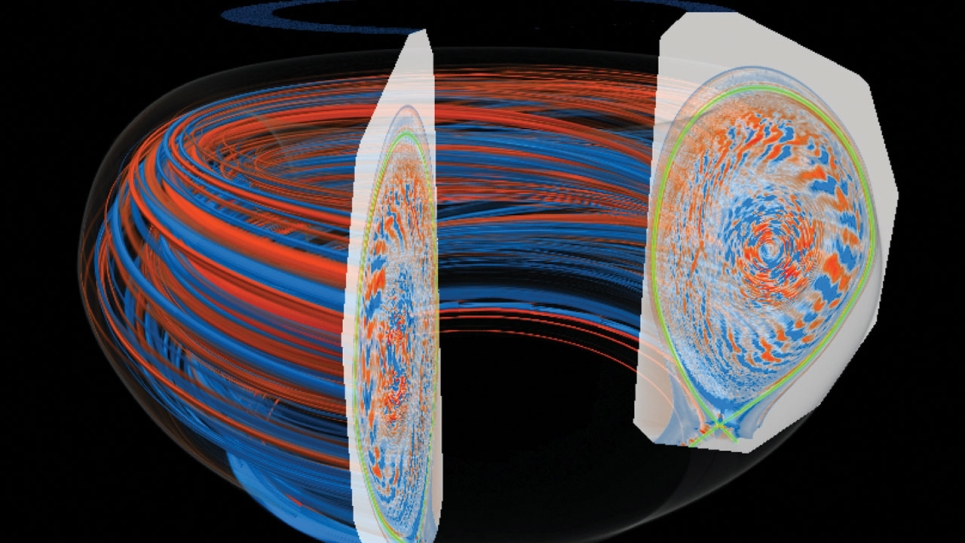
Heterogeneous graph neural network-based digital twin: combination of graph convolution and node attention for transient progress prediction. Image: Liu et al., Nuclear Technology 211(9), 2206–23 (2024).
Heterogeneous graph neural network-based digital twin: combination of graph convolution and node attention for transient progress prediction. Image: Liu et al., Nuclear Technology 211(9), 2206–23 (2024).
Heterogeneous graph neural network-based digital twin: combination of graph convolution and node attention for transient progress prediction. Image: Liu et al., Nuclear Technology 211(9), 2206–23 (2024).
Modeling and predicting the behavior of complex nuclear reactor systems at scale presents a critical challenge for advancing reactor technology. Conventional simulation methods often struggle to deliver rapid, accurate insights necessary for real-time reactor operation and decision making. To overcome this, Argonne researchers have developed an innovative digital twin technology that leverages artificial intelligence to improve reactor efficiency, reliability, and safety.
Traditional reactor simulation tools, while accurate, are computationally intensive and slow, limiting their utility for real-time monitoring and control. Furthermore, capturing the intricate interactions among diverse reactor components requires a modeling approach that can handle complex relational data efficiently. Addressing these challenges is essential for next-generation reactors, including small modular and microreactors, which demand enhanced operational agility.
The team introduced a novel methodology that represents entire nuclear reactor systems as heterogeneous graphs, where nodes correspond to various physical components and edges represent their interconnections. Using graph neural networks (GNNs), which excel at capturing relationships in such data, the researchers developed a digital twin that models the reactor’s dynamic behavior. Training utilized simulation data generated by Argonne’s System Analysis Module (SAM), and computing resources from the ALCF enabled scalable training and uncertainty quantification.
The GNN-based digital twin rapidly and accurately predicts reactor responses to operational transients, including power fluctuations and cooling system changes. Case studies on the Experimental Breeder Reactor II (EBR-II) and a generic fluoride-salt-cooled high-temperature reactor (gFHR) demonstrated the model’s precision and speed, surpassing traditional simulations. The digital twin can infer whole-system status from sparse sensor data and detect anomalies early, supporting proactive maintenance and reducing operational costs.
This AI-driven digital twin approach offers a transformative tool for managing advanced nuclear reactors, enhancing safety, autonomy, and efficiency. By enabling real-time system monitoring and predictive control, the technology supports longer component lifespans and lowers operational expenses. The work represents a significant advancement toward intelligent reactor operations, with broad implications for the future deployment of safe, cost-effective nuclear energy solutions.
Liu, Y., F. Alsafadi, T. Mui, D. O’Grady, and R. Hui. “Development of Whole System Digital Twins for Advanced Reactors: Leveraging Graph Neural Networks and SAM Simulations,” Nuclear Technology (October 2024), Taylor and Francis Group. https://doi.org/10.1080/00295450.2024.2385214