Ab Initio Theory Derived High-Fidelity Kinetics Databases

PI Sarah Elliott, Argonne National Laboratory
Co-PI Clayton Mulvihill, Baylor University
Luna Pratali Maffei, Politecnico di Milano
Andreas Copan, University of Georgia
Carlo Cavallotti, Politecnico di Milano
Yuri Georgievski, Argonne National Laboratory
Ab Initio Theory Derived High-Fidelity Kinetics Databases

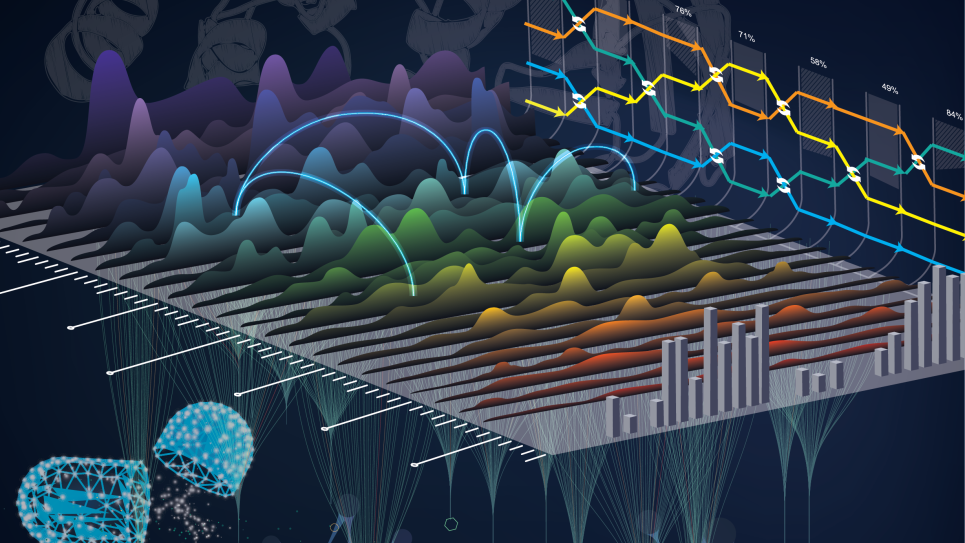
A large-scale kinetic database, spanning many chemical domains, including combustion, atmospheric chemistry, astrochemistry, and synthesis, will be constructed by deploying our open-source AutoMech software on Aurora. The automated workflow will refine and extend hundreds of thousands of stationary point data from existing electronic structure databases and convert them to rate constants that are practical to model chemical processes and train machine-learning models. Image: Sarah Elliott, Argonne National Laboratory

Project Summary

This project is using exascale simulations and first-principles calculations to generate an open-source, high-accuracy database of gas-phase reaction rates and thermochemical properties, enabling more predictive modeling of chemical kinetics across diverse applications.

Project Description

Gas-phase chemical kinetic modeling is paramount in numerous applications, including atmospheric chemistry, particle synthesis, combustion, pyrolysis, plasmas, chemical vapor deposition, and astrochemistry. These kinetic models are used to better understand the global chemical conversions occurring in these environments and thereby help optimize the devices and processes of interest. Underlying such modeling efforts are chemical kinetic mechanisms, which can comprise thousands of species participating in many thousands of reactions. Existing chemical mechanisms are often largely empirical in nature, being derived from fairly crude rate rules. This empiricism severely limits their predictive capabilities outside their explicit range of validation. Ultimately, researchers would like to use AI to develop improved mechanisms, but effective AI requires much more substantive and accurate databases of rate constants than currently exist.

To remedy this situation, this project proposes to generate large-scale state-of-the-art first-principles theory-based kinetics databases using the ALCF’s Aurora exascale supercomputer. The team’s open source code, AutoMech, will first be utilized to assimilate the data from several publicly available databases of structures and energies, which will then be improved through higher-accuracy quantum chemical calculations. The improved energetic data will then be transformed into a database of rate constants and thermochemical properties (the building blocks of kinetic mechanisms) through master equation simulations with the team’s MESS code. Moreover, this kinetic database will be greatly expanded to better represent radicals, whose reactions play a central role in chemical conversion processes. Through the unique capabilities of the ALCF, an unprecedented number of reactions will be studied at the highest feasible levels of accuracy. The open-source database generated in this project will enable enhanced simulations in a wide range of applications. Furthermore, it is expected to reveal exciting new possibilities for the development of effective AI models for gas phase kinetics.

Domains
Allocations