Challenge
DESI has created the most precise 3D map of the universe to date, spanning nearly 15 million galaxies and quasars. While its observations largely support the standard model of cosmology, growing tensions appear when the data are combined with other measurements from studies of the cosmic microwave background, supernovae, and weak gravitational lensing. The inconsistencies point to the possibility that dark energy may evolve with time rather than remain constant. To test this idea, researchers need extremely large, high-resolution simulations that can separate true signatures of evolving dark energy from effects introduced by data collection and analysis.
Approach
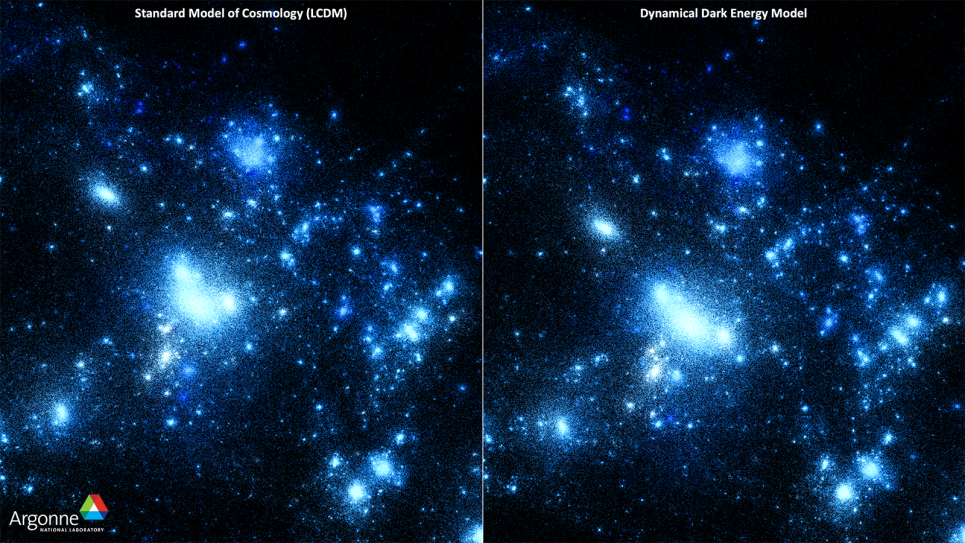
Building on years of carrying out large-scale cosmology simulations on DOE’s leadership supercomputers, the Argonne team used the HACC (Hardware/Hybrid Accelerated Cosmology) code on Aurora to perform a pair of high-resolution N-body simulations with identical starting conditions: one assuming a constant cosmological constant and another allowing dark energy to vary over time. Aurora’s immense processing power enabled them to achieve the fine resolution necessary to detect subtle structural differences, completing each simulation in days rather than the weeks required on earlier systems. The team also applied on-the-fly analysis methods to process data as it was generated, eliminating storage and postprocessing bottlenecks and providing rapid insights to refine simulations in real time.
Results
The team’s simulations revealed clear structural contrasts between constant and evolving dark energy models, establishing a controlled benchmark for interpreting DESI data. By making these datasets publicly available, the Argonne team has provided the cosmology community with a valuable resource for testing analysis strategies and refining models at a pivotal moment as DESI observations continue to strengthen the case for evolving dark energy.
Impact
Serving as a foundation for interpreting DESI data, the team’s simulations are enabling researchers to explore the potential evolution of dark energy, a possibility that would represent a major shift in our understanding of the universe. Their work highlights the important role that exascale systems like Aurora can play in testing theoretical models against observations at unprecedented scale and speed, allowing scientists to respond rapidly to new results from DESI and other state-of-the-art cosmological surveys.
Publications
Beltz-Mohrmann, G. D., A. Pope, A. Alarcon, M. Buehlmann, N. Frontiere, A. P. Hearin, K. Heitmann, S. Ortega-Martinez, A. Pearl, E. Rangel, S. Rizzi, T. Uram, and E. Xhakaj. “Illuminating the Physics of Dark Energy with the Discovery Simulations,” The Open Journal of Astrophysics (June 2025), Maynooth Academic Publishing.
https://doi.org/10.33232/001c.140866