ALCF projects cover many scientific disciplines, ranging from biology and physics to materials science and energy technologies. Filter ongoing and past projects by allocation program, scientific domain, and year.
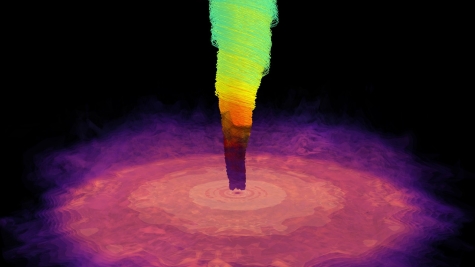
Radiation-Dominated Black Hole Accretion
This project uses a performance-portable GR radiation magnetohydrodynamics code with full radiative transfer to simulate radiation-dominated black hole accretion flows, enabling more accurate tests of theoretical models and observational methods for measuring black hole properties.
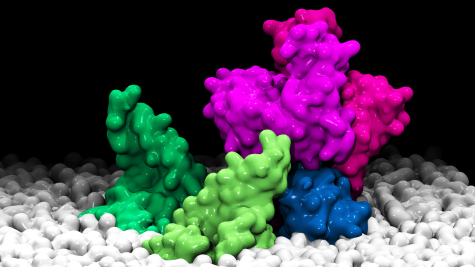
Large-Scale Simulations of Inner-Ear Mechanotransduction Complexes
This project applies large-scale molecular dynamics simulations to model the inner-ear mechanotransduction apparatus, aiming to elucidate how mechanical forces are converted into sensory signals and how disruptions lead to hearing and balance disorders.
Experimental Realization of Certified Randomness from Quantum Supremacy
This project develops and evaluates a practical protocol for certified randomness generation using quantum computers, with classical supercomputers used for verification, to improve the reliability and scalability of secure random number generation for cryptographic and other applications.

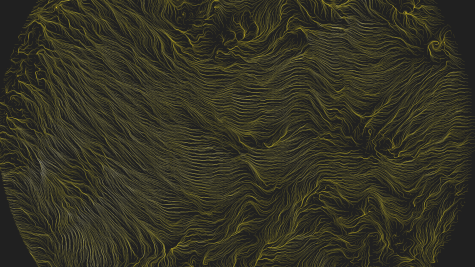
Exascale Simulations of Rayleigh-Benard Convection
This project uses GPU-accelerated direct numerical simulations of turbulent Rayleigh–Bénard convection at unprecedented Rayleigh numbers to investigate heat and momentum transport and the transition to fully turbulent boundary layers in convective flows.
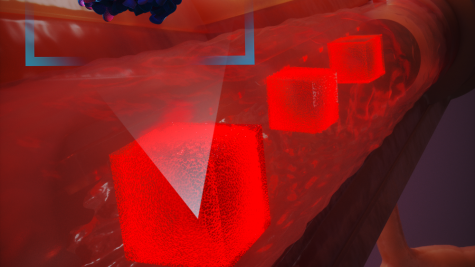
Establishing Digital Twins for High-Throughput Cellular Analysis in Whole Blood
This project develops a digital twin of a microfluidic device using Advanced Physics Refinement to enable high-throughput mechano-phenotyping by modeling cellular behavior in realistic blood environments and complex geometries.
Exascale Simulations of Compact Binary Mergers
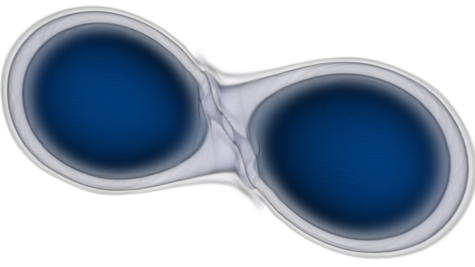
This project performs high-fidelity simulations of compact binary mergers using general-relativistic magnetohydrodynamics and neutrino transport to improve models of gravitational-wave signals and electromagnetic counterparts, supporting interpretation of multimessenger astrophysical observations.
High-Fidelity Simulations of Open Fan/Wing Integration for Sustainable Aviation
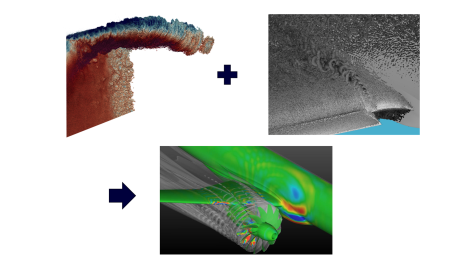
This project uses exascale high-fidelity simulations and machine learning to study the flow physics of wing-mounted open fan propulsion systems, improving predictive models for aircraft–engine integration to support more efficient and lower-emissions aircraft design.
Carbon at Extremes: Discovery Science with Exascale Computers
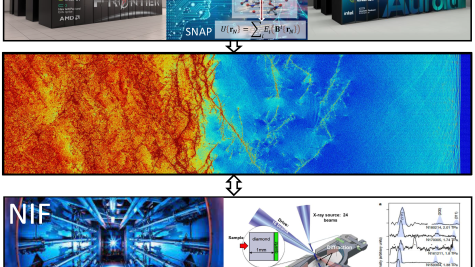
This project uses exascale quantum-accurate molecular dynamics simulations to study carbon under extreme pressure and temperature, aiming to understand phase transformations, deformation, and shock-driven behavior relevant to the synthesis of novel carbon phases and high-pressure material physics.
Using Exascale Computing for New Insights into High-Lift Ground Testing
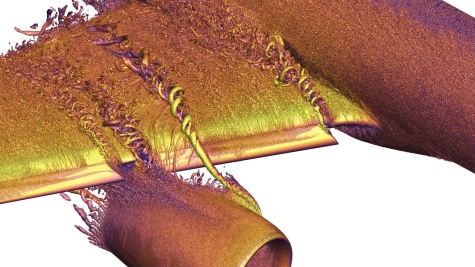
This project uses exascale computing to simulate high-lift aerodynamic flows in coordination with wind-tunnel testing, with the goal of improving the reliability of computational predictions for aircraft certification and reducing the need for costly physical testing campaigns.
Heteropolymer Design Harnessing New and Emerging Computing Technologies
This project develops and scales advanced computational methods for heteropolymer design and validation on DOE supercomputers, including exploration of quantum-inspired algorithms, to enable the creation of complex molecules for drug development, enzyme engineering, and materials design.

Scalar Transport in Turbulent Bubbly Flows: Insights from Interface-Resolved Simulations
This project uses fully resolved direct numerical simulations of gravity-driven turbulent bubbly flows to quantify turbulence, mixing, and scalar transport processes at all relevant physical scales, supporting improved predictive understanding of multiphase flow systems with heat and mass transfer.
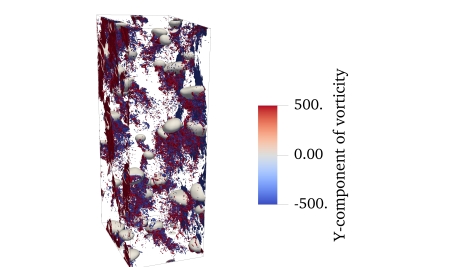
Advancing Fusion and Fission Energy through Exascale
This project develops high-fidelity, exascale-scale multiphysics simulations of advanced fission and fusion reactor systems to improve predictive modeling capabilities needed for the design, certification, and deployment of next-generation nuclear energy technologies.
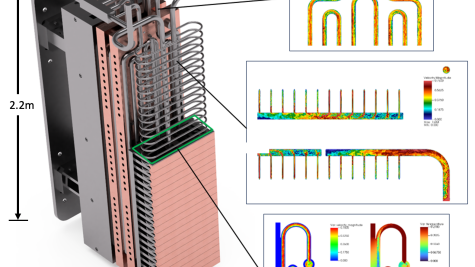
High-Fidelity Turbulence-Based Predictions of Stellarator Reactor Performance
This project uses multiscale plasma turbulence simulations on DOE supercomputers to predict and optimize transport in stellarator fusion devices, supporting the design of more efficient reactor concepts for commercial fusion energy.
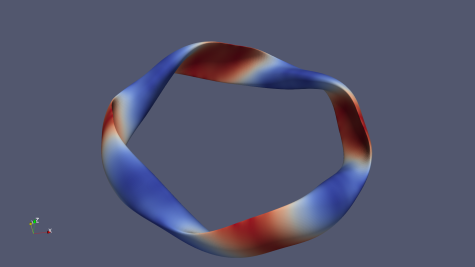
Multi-Resolution Genome Folding: Ensemble 3D Structures Across Diverse Tissues
This project uses large-scale computational modeling to reconstruct 3D genome organization across multiple cell types, enabling analysis of how chromatin structure influences gene regulation, cellular function, and disease-associated genetic variation.
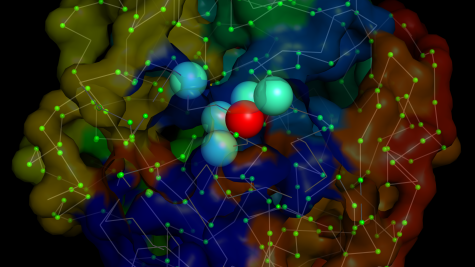
Exascale Simulation of Correlated Electron-Phonon Coupling in Quantum Materials
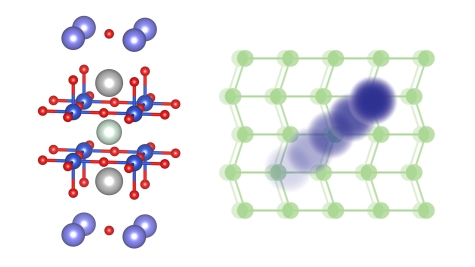
This project uses exascale GW and Bethe–Salpeter equation calculations to study electron–phonon coupling in correlated quantum materials, improving predictive understanding of interactions that govern phenomena such as superconductivity and charge-density waves.
Advances in Quark and Lepton Flavor Physics with Lattice QCD
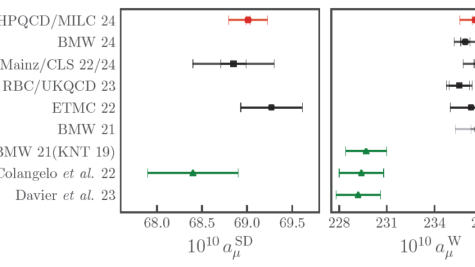
This project uses lattice quantum chromodynamics simulations, including electromagnetic and quark-mass corrections, to study key problems in particle physics such as the muon anomalous magnetic moment, heavy meson decays, and CP violation in the kaon system, supporting high-precision experimental efforts.
Heterogeneous Reaction Dynamics for Energy Storage and Hydrogen Production
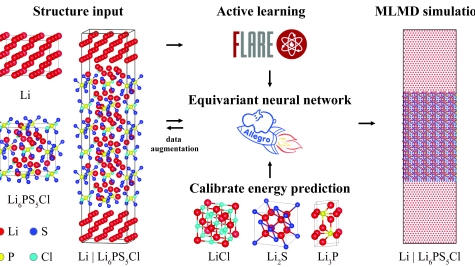
This project uses machine learning–trained force fields and large-scale molecular dynamics simulations on DOE supercomputers to study atomic-scale processes at battery and catalytic interfaces, improving understanding of degradation, transport, and reactivity relevant to energy storage and hydrogen production.
Exascale Simulations of Quantum Materials
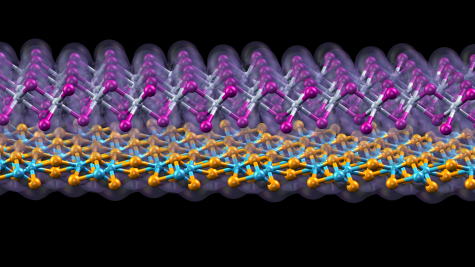
This project uses Quantum Monte Carlo simulations with the QMCPACK code to perform high-accuracy electronic structure calculations of quantum and two-dimensional materials, providing benchmark-level predictions for systems where conventional methods are unreliable.
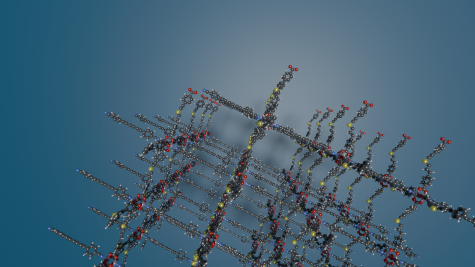
MOFA: Generative AI-Driven MOF Discovery for Carbon Capture at Exascale
This project develops an exascale computing framework that integrates generative AI and atomistic simulations to discover and evaluate metal-organic frameworks for carbon capture, producing a validated materials database optimized for performance, stability, and manufacturability.
Ab-initio Nuclear Structure and Nuclear Reactions
This project uses DOE supercomputers to perform advanced nuclear theory simulations that predict the structure and reactions of atomic nuclei and their interactions with neutrinos and electrons, supporting experimental and theoretical studies in nuclear physics, astrophysics, and related applications.