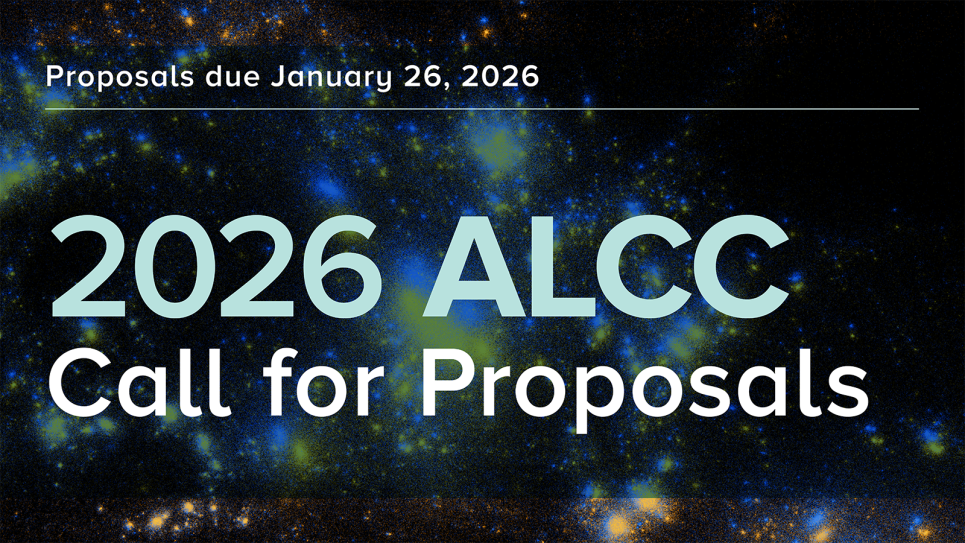
Enabling experiment-time data analysis at the Advanced Photon Source Science By integrating DOE supercomputers, including ALCF’s Polaris, with the upgraded Advanced Photon Source, Argonne researchers are enabling rapid data analysis to help guide experiments as they unfold. APEX proposals due Feb. 27 Call for Proposals The ALCF is now seeking proposals for its new AI Program for EXploration (APEX), a collaboration and development program designed to fast-track novel applications of AI in science. Selected projects will receive access to ALCF's HPC and AI resources, as well as staff support and an ALCF-funded postdoctoral researcher. Aurora News Aurora Science and User News Accelerating Scientific Discovery through Advanced Computing U.S. Department of Energy 2025 Office of Science Year in Review: Advances in Discovery Science Department of Energy Scholars Achieve Groundbreaking Calculations of Luminous Black Hole Accretion Institue for Advanced Study Argonne’s Aurora Supercomputer Enables Trillion-Atom Light–Matter Simulations HPCwire Learn More About Aurora RADAR: A new era of collaborative cosmic exploration Science With help from ALCF's Polaris supercomputer, researchers developed RADAR, an AI-powered framework designed to advance multi-messenger astrophysics. ATPESC 2026 applications due Feb. 25 HPC Training Aimed at graduate students, postdocs, and computational scientists, APTESC provides training on the key skills and tools needed to use the world’s most powerful supercomputers for scientific research. OpenMC drives innovation in nuclear and fusion energy research Science Optimized to run on supercomputers, including ALCF’s Aurora exascale system, OpenMC enables researchers to simulate entire fission reactors and fusion devices with unprecedented detail. Argonne and the ATLAS experiment Science As part of Argonne’s long-standing contributions to the ATLAS experiment, teams are leveraging ALCF supercomputers, including Aurora, to process, simulate, and analyze growing volumes of ATLAS data